The Jar on My Counter Beat Every Budgeting App I've Ever Paid For

Photo: James St. John, CC BY 2.0, via Wikimedia Commons
I have paid for at least four budgeting apps. One had pie charts. One had an AI coach named something like "Max." One sent me push notifications at 11 p.m. about my latte spending. And every single one of them is currently sitting uninstalled on some digital scrapheap, because I stopped opening it after three weeks.
Meanwhile, a glass jar on my kitchen counter — no notifications, no dashboard, no subscription — quietly collected $1,544 last year. It used the dumbest-sounding method on the internet: the daily incremental savings ladder. And I'm here to make the case that it beats every sophisticated system I've ever tried.
The Rule in One Sentence
Save $1 on day one, $2 on day two, $3 on day three... all the way to $365 on the final day of your year. Do that every day and you'll bank $66,795.
Wait — that's the version for people with tech salaries. Let's be honest with each other: most of us can't drop $365 on day 365. But the beauty of the ladder is that you can adjust every rung without breaking the whole structure.
The Math, Because the Math Matters
A full 365-day ladder sums to $66,795. That's the viral version, and it's unrealistic for most households. But the formula is just:
Daily increment × (number of days × (days + 1)) ÷ 2
Which means you can scale it however you like:
- 10-cent ladder: 10¢, 20¢, 30¢... up to $36.50 on day 365 = $6,679.50
- 25-cent ladder: up to $91.25 on the final day = $16,698.75
- 50-cent ladder: up to $182.50 = $33,397.50
- $1 ladder (the classic): $66,795
The dime ladder is the sleeper pick. Nobody misses a dime on day one, and even the steep end — $36.50 — is roughly what a delivery order costs in fees alone. Six grand a year from pocket change and skipped convenience spending.
Why It Outperforms Fancy Apps (In My Highly Unscientific Trial)
Here's my honest theory about why the ladder works when dashboards don't:
1. It's frictionless by design. Budgeting apps require categorization, syncing, reconciliation. The ladder requires one decision, once: how big is my increment? After that, there's nothing to manage. The system is the habit.
2. It's visible. Behavioral finance people call this "making progress tangible." A savings account balance that ticks up daily, or a jar that physically fills, gives your brain a daily scoreboard. An app notification is easy to swipe away; a jar that's two-thirds full is not.
3. It grows with your buy-in. Early days cost almost nothing, which builds the habit before the stakes rise. By the time the amounts feel meaningful, saving is already who you are. It's the financial equivalent of a couch-to-5K program.
4. It survives bad days. Miss a day? Most laddering folks just make it up over the weekend or double up later. A budget, by contrast, tends to shatter on the first bad week and never gets rebuilt.
App Subscriptions vs. A Jar: The Absurd Comparison
Let's put real numbers on this. Premium budgeting apps run roughly $40–$100 a year. That's money you pay for the privilege of feeling guilty about your spending.
My jar cost $0. My auto-transfer version — because yes, I eventually moved the money into a high-yield savings account earning real interest — cost $0 and paid me about 4% APY on the growing balance. Over a full dime-ladder year, interest adds roughly another $130–$150 depending on timing.
So the scoreboard reads: Jar + HYSA: ~$6,800, cost $0. Premium app: $0 saved (by me, anyway), cost $60.
I'm not saying apps are useless — for tracking spending and catching subscription creep, they're genuinely helpful tools. But as a savings engine, complexity is a feature apps charge for and a bug humans suffer from.
Build Your Own Ladder — Starting on Any Day
Here's the part nobody tells you: you don't have to start January 1st. The ladder works on any day, because it's built on 365 increments, not calendar dates. My current run started on a random Tuesday in March.
Step 1: Pick your increment. Dime if money's tight, quarter if comfortable, dollar if ambitious. You can also do a "capped ladder" — increments grow for 90 days, then hold steady, which softens the end-of-year crunch.
Step 2: Automate it (sort of). Two good options: a weekly auto-transfer equal to your coming week's ladder total, or a daily transfer of the increment. Weekly is easier; daily feels better.
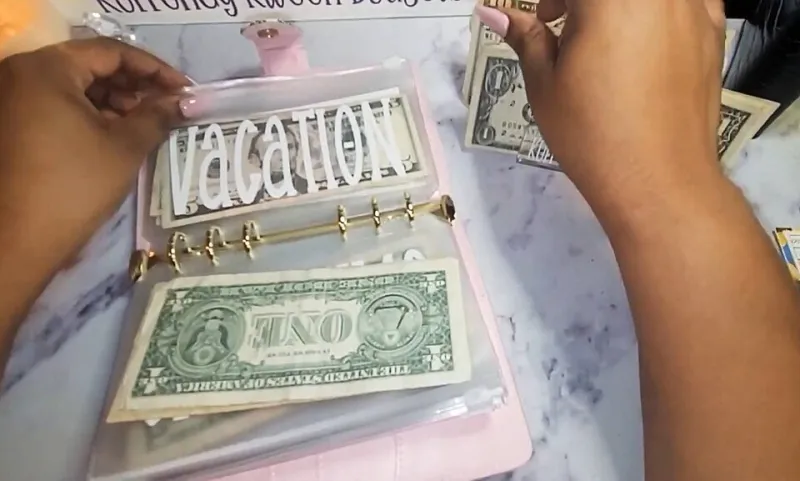
Step 3: Keep a visible tracker. A paper chart on the fridge, a note on your mirror, a jar for cash people. The visibility isn't decoration — it's the mechanism.
Step 4: Name the account. "Emergency fund" is boring. "The Escape Hatch" or "Next Year's Vacation" gives the money a job, and money with a job gets kept.
Step 5: Pre-decide the miss rule. Mine: any missed day gets made up within the week, or forgiven entirely. Guilt kills savings systems faster than spending does.
The Uncomfortable Truth About Simple Money Rules
Part of me feels embarrassed recommending something this simple. Surely personal finance should be harder? Shouldn't there be a spreadsheet, an allocation strategy, at least one chart with a pie in it?
No. That's the whole lesson of the last few years of personal finance culture: the systems that win aren't the smartest ones, they're the ones you'll actually still be doing in month nine. The ladder is boring, visible, forgiving, and mathematically legitimate. It doesn't care what day it is or how your year is going.
Start tomorrow with a dime. By this time next year, you'll have a few thousand dollars, a habit you didn't have to force, and — if you're like me — a slightly smug feeling every time you walk past an app store subscription page.