Lending Uncle Sam Money for Free? The Paycheck Mistake Millions Make Every January
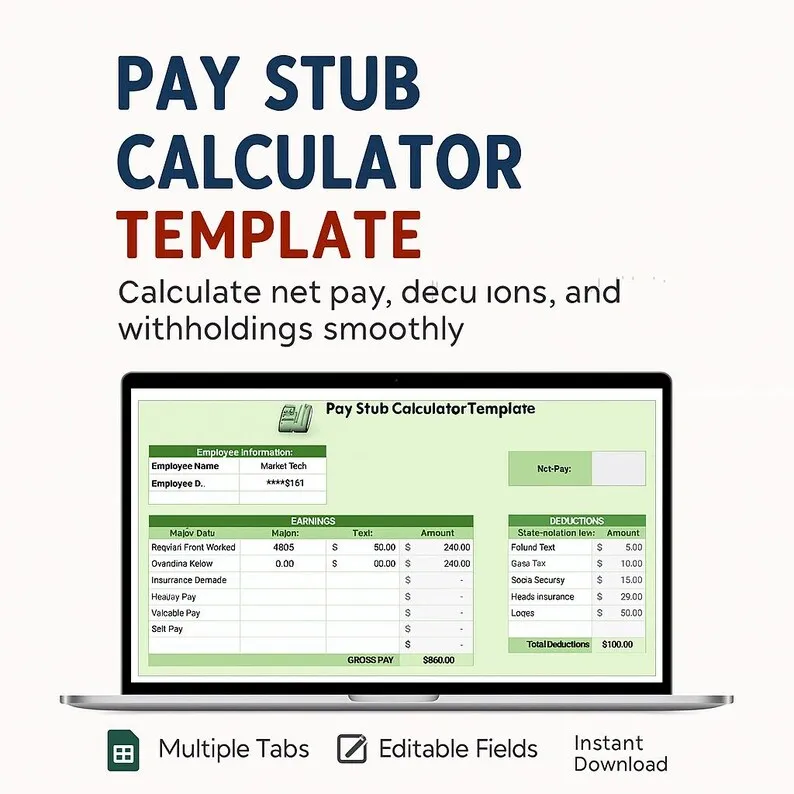
Photo: paycheck stub calculator desk tax documents, via i.etsystatic.com
Every spring, millions of Americans post the same celebration on social media: a screenshot of a fat tax refund, framed as a windfall. Free money from the government! Except it isn't free, and it isn't a windfall. It's your money — the money your employer quietly skimmed from every paycheck since January, held by the IRS for up to a year, and returned to you with zero interest.
Let's call it what it is: the largest interest-free loan most Americans will ever give anyone, and they give it voluntarily.
The Refund Illusion
Here's the math nobody talks about at the water cooler. The average federal refund hovers around $3,000. If you get one, that means you overpaid by roughly $250 every single month — money that could have been covering groceries, padding an emergency fund, or earning yield in a high-yield savings account currently paying north of 4%.
Instead, that cash sat in the Treasury's coffers. The government got a free loan. You got a one-time payout in April and, if you're lucky, a thank-you note.
There's a reason the refund feels good. Behavioral economists have studied it for decades: people treat lump sums differently than steady income. A $3,000 refund gets spent on a vacation or a couch; $250 a month would have quietly dissolved into the budget. But "feels good" and "good for you" aren't the same thing. You can have the lump sum and the interest — you just have to build it yourself.
How Much Are You Actually Lending?
Want to know the size of your interest-free loan? It takes about five minutes.
- Pull your last paycheck. Find the year-to-date federal income tax withheld.
- Compare it to your expected tax bill. Use last year's return as a baseline, or run your numbers through the IRS Tax Withholding Estimator (it's free, and no, it won't bite).
- Do the division. If you'll withhold $10,000 but owe $7,000, you're lending the government $3,000 — for free, for months.
If the gap is small, a few hundred dollars, the fix may not be worth the hassle. But if you're in the thousands — and millions of households are — that's real money with a real opportunity cost.
The W-4: The Most Powerful Form You Never Read
The fix lives on a form called the W-4, the one you filled out on your first day and never looked at again. Since the 2020 redesign, it no longer uses allowances — instead it asks about dependents, other income, and deductions directly. Most people fill it out once, guess conservatively, and over-withhold for years.
A few levers worth knowing:
- Dependents and credits. If you have kids, the Child Tax Credit should be reflected here. Leaving it off means the IRS holds up to $2,000 per child all year.
- Other income. A spouse who works, freelance income, or investment gains? Accounting for it prevents both over- and under-withholding.
- Extra withholding. The flip side: if you tend to owe money, you can add a flat dollar amount per paycheck. This is the right tool for side hustlers who don't want a surprise bill in April.
Submit the updated W-4 to HR — most payroll systems let you do it in an afternoon — and the change shows up on your next check.
Turning a Refund Into a Pay Raise
Here's where it gets satisfying. Say adjusting your W-4 frees up $250 a month. Don't let it evaporate into the checking account — that's how the refund used to work, just slower.
Instead, automate it the day the form takes effect:
- High-yield savings account. $250 a month at 4% APY compounds to over $3,000 in a year — plus you earned roughly $60 in interest the Treasury would have kept. Small number, big principle: your money works for you now, not the government.
- Emergency fund first. If you don't have three months of expenses saved, this is the fastest way to build one without noticing.
- Debt, if the math says so. An extra $250 a month against a 22% credit card balance saves far more than any savings account pays. Kill the debt, then redirect.
Set the transfer for payday, before the money gets comfortable. Automation beats willpower every time — a lesson this site has preached in one form or another all year.
When a Refund Actually Makes Sense
Full disclosure: over-withholding isn't always a mistake. If you genuinely cannot trust yourself to save — and plenty of smart people can't — the IRS-as-forced-savings-account isn't the worst plan. It's expensive (zero interest), but it works. Self-employed folks with unpredictable income also sometimes deliberately pad their withholding to cover quarterly estimates.
And if you're getting a refund because of refundable credits like the Earned Income Tax Credit, that's not a loan at all — that's money you're entitled to, full stop.
But for the millions of W-2 earners who over-withhold by accident, out of inertia? That's not a strategy. That's a default you never chose.
The 15-Minute January Project
Tax season is the natural time to do this — your return is fresh, your numbers are accurate, and you have twelve months of paychecks ahead to benefit. Block out fifteen minutes this week:
- Compare last year's withholding to last year's tax bill.
- Run the IRS withholding estimator with your current situation.
- Update your W-4 if the gap is meaningful.
- Automate the freed-up cash into a high-yield savings account the same day.
Next April, you won't be posting a refund screenshot. You'll be twelve months into a savings habit that never missed a beat — and unlike a refund, nobody had to lend your money back to you to get it.